
A Practical Guide for Builders, Flippers, and GCs
Quick Takeaway: Trade Specifications for Cabinet Finishing
- Do commercial 2K alkyd/acrylic hybrid enamels outperform 1K architectural trim paints on cabinets today?
Modern commercial 1K hybrid enamels cure into a non-porous surface meeting KCMA standards, previously only achievable by 2K products, whereas modern 1K cabinet paint (such as Gallery by Sherwin Williams) outperform all other 1K products currently on the market. The hybrid formulation provides the hard leveling and block resistance of an industrial alkyd alongside the non-yellowing UV stability of acrylics, preventing peeling at pulls and sticking along door bumpers. - How does an 80/20 off-site finishing workflow reduce contractor schedule delays?
Removing 80% of cabinet doors and trims to an off-site shop eliminates trade stacking, keeping the job site accessible to other trades. On-site face-frame masking and spraying requires only 2 to 3 days of localized negative-air containment, preventing multi-week room closures and overspray contamination. - Can open-grain oak cabinets be refinished to match smooth contemporary factory millwork?
Yes, through knife-grade grain filling, mechanical sanding, and high-build bonding primers that level open pores prior to topcoating. This process bridges deep earlywood valleys, creating a flat profile comparable to paint-grade maple or new HDF doors.
In residential construction, spec building, and high-end flips across West Michigan, millwork and cabinetry are consistently high-risk line items for punch-list delays and warranty callbacks.
When a project experiences timeline drag, the cause is often trade stacking: painters, tile setters, trim carpenters, and electricians stepping on each other in the kitchen. When a homeowner issues a warranty callback six months post-occupancy, the culprit is often coating failure: peeling sink rails, chipped handle edges, and doors sticking to face-frame bumpers.
Achieving a durable finish on architectural woodwork requires understanding the chemical and logistical differences between standard residential trim painting and commercial shop spray finishing.
Here is an objective technical breakdown of coating chemistries, application environments, and production logistics to help general contractors, real estate investors, and project managers protect their margins and schedules.
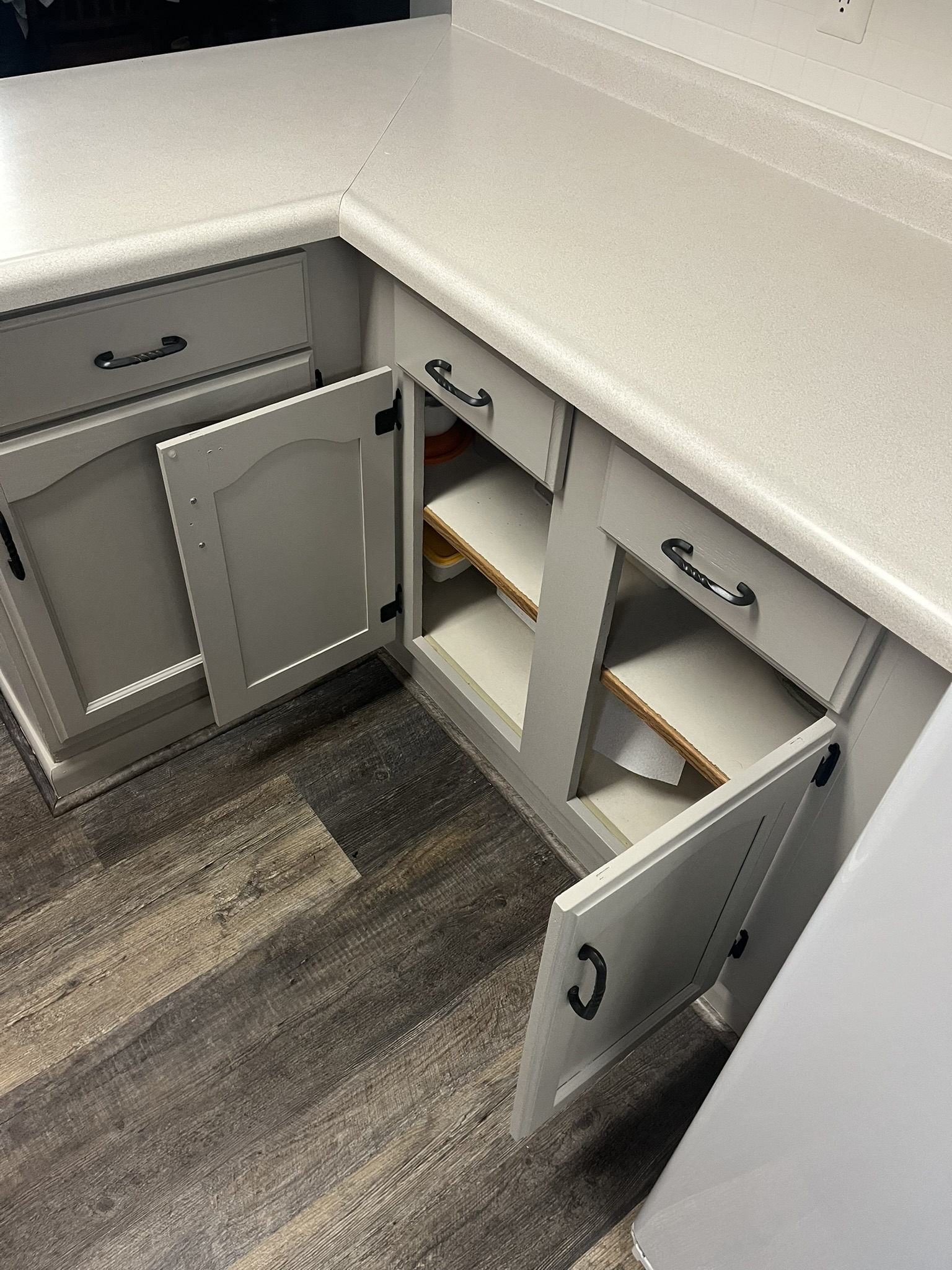
Latex vs. Enamel vs Urethane vs Modern 1K Cabinet Paint
Architectural wood coatings behave according to their resin formulation and curing mechanisms. Applying a standard wall or trim paint to high-touch cabinetry creates long-term adhesion and wear issues.
1. Standard 1K Architectural Acrylic/Latex Paint
- Curing Mechanism: Simple physical evaporation of water.
- Film Structure: Forms a thermoplastic, flexible latex film.
- Hardness & Block Resistance: Low film hardness; poor block resistance. In humid conditions, doors stick to face frames and pull paint away.
- Chemical Vulnerability: Porous binder structure absorbs acidic skin oils, cooking grease, and household cleaners, causing softening and peeling around pulls within 12 to 24 months.
- Trade Context: Suitable for stationary baseboards and drywall, but not engineered for high-contact, vertical-use casework.
2. Waterborne Urethane-Modified Alkyds (Retail 1K Hybrids)
- Curing Mechanism: Coalescence followed by slow atmospheric oxidation.
- Film Structure: Harder than pure latex, but heavily plasticized to accommodate brush-and-roller DIY application.
- Limitations: Long open times mean slow film builds and extended vulnerability to airborne job-site dust nibs. When brushed or rolled in the field, lap lines and stipple remain visible.
3. Commercial-Grade Alkyd/Acrylic Hybrid Enamels (Shop-Sprayed)
- Curing Mechanism: Dual-action coalescence and accelerated auto-oxidation.
- Film Structure: Combines the hard, self-leveling resin structure of an industrial alkyd with the non-yellowing, flexible UV stability of high-molecular-weight acrylic polymers.
- Performance Benchmark: Meets Kitchen Cabinet Manufacturers Association (KCMA) standards for heat, chemical resistance, and moisture immersion.
- Block Resistance: Achieves high block resistance quickly once dried, preventing doors from sticking to rubber bumpers even in coastal lakefront humidity.
- Color Stability: Unlike solvent-based oil enamels, the acrylic backbone prevents dark-room yellowing and amber oxidation on white and light-neutral specifications.
The Job-Site Finishing Bottleneck: Field Application vs. The 80/20 Shop Model
Beyond chemical durability, cabinet finishing introduces logistical hurdles on an active job site.
Field-finishing an entire kitchen locks down the most valuable room on the job site. Spraying doors and boxes on-site forces general contractors to halt adjacent trades to avoid dust contamination in wet finishes or exposure to paint overspray. This trade stacking frequently costs general contractors 7 to 10 days of lost site access.
The 80/20 Production Model
To eliminate trade collisions, The Decorators Choice divides production into an 80% off-site, 20% on-site workflow:
- Phase 1: Complete Off-Site Intake (Day 1). All doors, drawer fronts, dummy panels, and loose architectural moldings are cataloged, hardware-stripped, and transported to our dedicated spray facility at 336 Broadway St. in South Haven.
- Phase 2: Climate-Controlled Shop Finishing (Days 1–4). Off-site components undergo chemical degreasing, mechanical sanding with direct HEPA extraction, high-solids bonding primers, and multi-pass spray booth application. Finishing in a filtered booth eliminates airborne dust nibs and ensures uniform mil-thickness.
- Phase 3: Localized Containment (Days 2–3). On-site face-frame prep and spraying are isolated within floor-to-ceiling static plastic barriers under continuous negative-air HEPA exhaust. Because 80% of the square footage is off-site, atomization inside the home is minimal, allowing adjacent trades (flooring, electrical, trim) to maintain site access.
- Phase 4: Mechanical Reassembly & Tuning (Day 5). Finished components return cured. Doors are rehung, reveals are balanced using 6-way hinge adjustments, and hardware is installed to the template.
Substrate Preparation: Oak Grain-Filling vs. Raw Millwork Stabilization
Different substrates require distinct preparation protocols to prevent telegraphing and structural cracking.
Managing 1980s–2000s Cathedral Oak in Flips and Remodels
Oak is ring-porous with deep, open earlywood pores. Applying enamel directly over oak results in uneven, textured grain that reads as painted wood rather than a factory-manufactured piece.
To achieve a contemporary surface comparable to paint-grade maple or high-density fiberboard (HDF):
- Chemical Decontamination: Removing embedded household waxes, silicones, and cooking oils.
- Knife-Grade Grain Filling: Applying high-solids paste grain filler across open pores.
- Mechanical Leveling: Sanding flat using direct-tool vacuum extractors.
- High-Build Surfacers: Applying high-solids bonding primer to seal remaining grain telegraphing prior to enamel topcoats.
Stabilizing Raw MDF and Custom Built-Ins in New Construction
For spec builders and custom millwork shops, raw MDF edges and maple joints absorb moisture unevenly. Raw edges must be sealed with specialized high-solids primers to prevent edge swell before receiving matching field coats.
The Craftsman Standard: 30+ Years of Regional Trade Experience
Founded in 1990 by master finisher Thomas Balke, The Decorators Choice has served as an independent wood-finishing resource for West Michigan builders, remodelers, and real estate professionals for over three decades.
"General contractors and builders cannot afford callbacks on sticky cabinet doors or chipped face frames when an owner moves in. We approach cabinetry like architectural furniture, not vertical drywall. By engineering 80% of the work in our shop, we protect the builder's critical path, keep trades moving, and deliver an enamel finish that passes final punch-list inspections on the first walk-through."
— Thomas Balke, Owner & Lead Craftsman
Known throughout Southwest Michigan for standards described by clients as "So meticulous, it's ridiculous," Thomas works directly with trade partners from initial scope evaluation through reassembly.
Designer Color Formulations and Architectural Specifications
Commercial-grade alkyd/acrylic hybrid coatings can be custom-formulated to match architectural palettes, including full collections from:
Custom physical control swatches
To assist designers, builders, and their clients with finish selections, every project includes access to complimentary finish coordination through our local design partner, Jaz Color & Design Studio.
Trade Subcontracting Details
- Direct Line (Call or Text Thomas): (269) 270-5785
- Trade Estimating & Plans: decoratorschoicesh@gmail.com
- Turnaround Window: Standard 3 to 5 business days for shop-and-site turnaround.
- Regional Coverage: South Haven, Saugatuck, Douglas, Holland, St. Joseph, Benton Harbor, Kalamazoo, Portage, Mattawan, and Lakeshore West Michigan.
- Credentials: Fully Insured Commercial General Liability | BBB Accredited Business (A+ Rated)